Selling Korean cosmetics in the EU: the complete guide for K-beauty brands (2027)
Europe now buys more Korean cosmetics than North America. Every product still needs the same EU groundwork before its first sale: an EU Responsible Person, a formula checked against the EU annexes, a safety report, a CPNP notification, an EU label and packaging EPR in each country it ships to.
Korea exported $11.1bn of cosmetics in the first nine months of 2026, up 31.1% and already close to the $11.4bn of the whole previous year. Skincare made up $8.72bn of it, up 45.1%. In the first half of 2026, Korean cosmetics exports to Europe passed those to North America for the first time, with Poland up 72.8%, the UK 150.6% and the Netherlands 220.4%.
Figure
Value
What it covers
Korea's cosmetics exports, Jan–Sep 2026
$11.1bn (+31.1%)
All destinations, a nine-month record
of which skincare, Jan–Sep 2026
$8.72bn (+45.1%)
All destinations
UK and Netherlands, Jan–Sep 2026
$443m (+179.3%) and $369m (+292.6%)
Two of the fastest-growing European markets
Growth to Poland, H1 2026
+72.8%
After more than doubling the year before
Korea's cosmetics exports, Jan–Oct 2026
$12.57bn
Already above the whole of the previous year ($11.4bn)
Exports to the EU, October 2026
$130m (+106.1%)
September 1–25: $170m (+110.4%)
Exports to Europe, H1 2026
$1.596bn
58 European countries, incl. the UK; North America: $1.570bn
Same five countries, Jan–May 2026
$290.78m (+76%)
UK $155.67m (+134%)
Growth to Poland, Jan–Sep 2026
+58%
Korea's 9th-largest cosmetics market
Germany's imports of Korean cosmetics, Jan–May 2026
Europe's cosmetics market sells about €110bn a year at retail, in Cosmetics Europe's latest annual figures. Skin care is the largest category at €32.3bn, which is where most K-beauty sits.
Country
Cosmetics retail a year
K-beauty in 2026
Germany
€18.0bn
Skincare and make-up from Korea +88% to $46.45m, Jan–May 2026
United Kingdom
€14.7bn
+134% to $155.67m, Jan–May 2026 (not in the EU: separate rules)
France
€14.5bn
Part of Korea's EU exports, +106.1% in October 2026
Only a cosmetic product with a Responsible Person established in the EU can be placed on the EU market (Article 4). For a product made in Korea, the importer is the Responsible Person, unless it appoints another EU person by written mandate, accepted in writing. The Responsible Person's name and address go on the label, and the product information file is kept at that address.
One Responsible Person covers the whole EU for a product. A Korean company can't be its own Responsible Person: it needs an EU importer, an EU subsidiary or a mandated EU company. EUR-Lex
Step 2: check every ingredient against the EU annexes
The EU works with lists: Annex II bans substances, Annex III restricts them, and Annexes IV, V and VI are the only colourants, preservatives and UV filters allowed. Several actives and filters common in Korean formulas were restricted between 2022 and 2026.
Ingredient
EU limit
Since
Retinol, retinyl acetate, retinyl palmitate
0.05% retinol equivalent in body lotion, 0.3% in other products, plus a warning
New products from 1 Nov 2025; all stock from 1 May 2027
Alpha-arbutin
2% in face creams, 0.5% in body lotions
New products from 1 Feb 2025; all stock from 1 Nov 2025
Arbutin
7% in face creams
Same dates
Kojic acid
1%, face and hand products only
Same dates
4-Methylbenzylidene camphor (UV filter)
Banned
Not placed from 1 May 2025; off the market from 1 May 2026
Benzophenone-3 (UV filter)
6% face, hand and lip; 2.2% body; 0.5% other
2023
Octocrylene (UV filter)
9% in propellant sprays, 10% in other products
2023
Fragrance allergens
Named on the label above 0.001% (leave-on) or 0.01% (rinse-off), from a much longer list
New products from 31 Jul 2026; all stock from 31 Jul 2028
Each product needs a cosmetic product safety report (Article 10 and Annex I): part A covers the data (formula, impurities, stability, microbiology, exposure, toxicology of each ingredient), part B is the safety assessor's conclusion. The assessor must hold a qualification in pharmacy, toxicology, medicine or a similar discipline.
The Responsible Person then keeps a product information file for ten years after the last batch is placed on the market (Article 11): the product description, the safety report, the manufacturing method with a statement of good manufacturing practice, proof of the effects claimed, and any data on animal testing. Ask your Korean manufacturer early for the full formula with percentages, stability and challenge tests, and the GMP certificate: these are what usually hold a file up. EUR-Lex
A pack printed for Korea rarely works as it is. The EU label carries the Responsible Person's name and address, the country of origin, the nominal content, the date of minimum durability or the period after opening, precautions, the batch number, the function unless it is obvious, and the INCI ingredient list (Article 19), in the languages each country requires. EUR-Lex
Step 6: claims, and why "functional cosmetic" doesn't travel
In Korea, whitening, anti-wrinkle and sunscreen products can be registered as functional cosmetics with the Ministry of Food and Drug Safety. The EU has no such category, and a claim that a product has been approved by an authority is not allowed (Regulation 655/2013, criterion 1). Every claim must be truthful, backed by evidence, honest, fair and clear to the average consumer. EUR-Lex
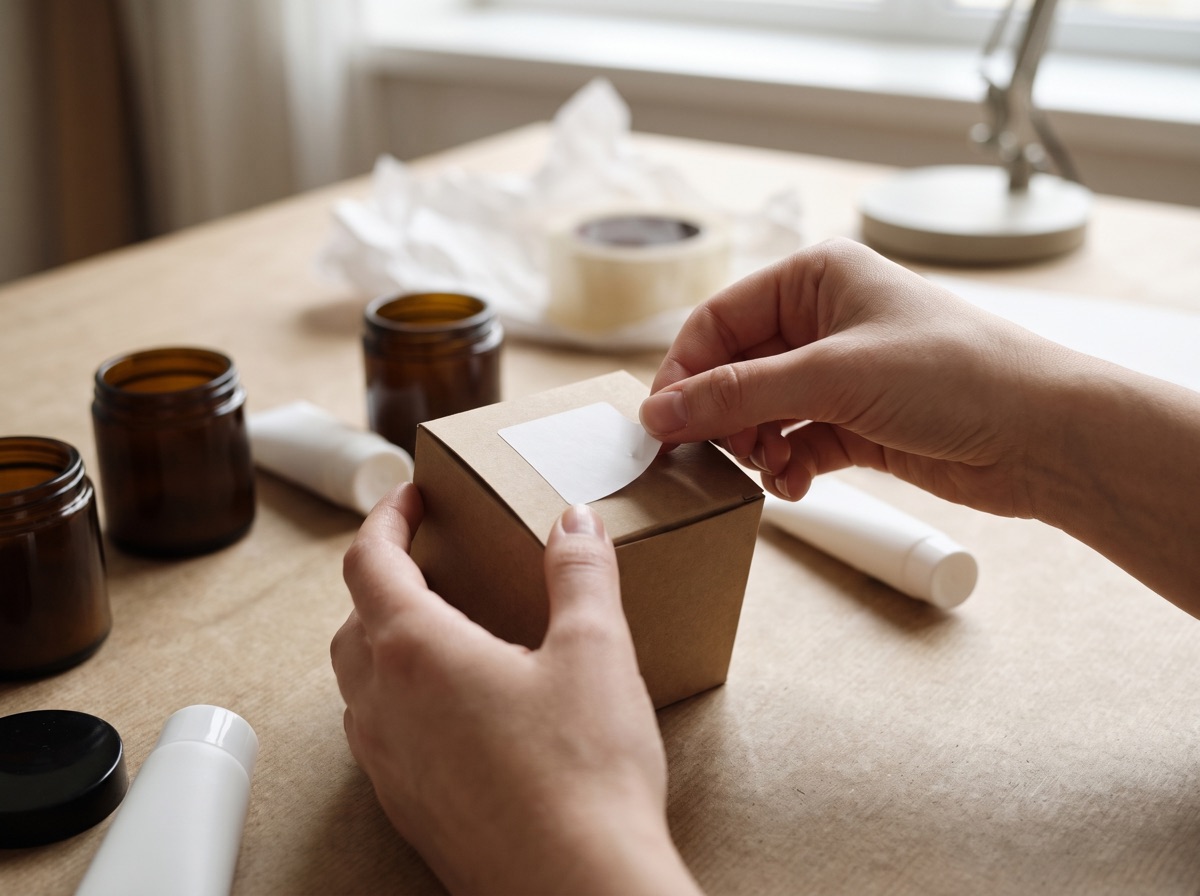
Jars, tubes, cartons and the shipping box are packaging. France, Germany and Spain each want their own producer registration before the first sale, through a representative established there when you are not, and marketplaces check the numbers.
Country
What you need
What marketplaces ask for
Germany
LUCID registration and a system participation contract
The LUCID registration number
France
Registration with an eco-organisme for household packaging
The unique identifier (IDU)
Spain
Registration in the producer register and a collective scheme
Check every formula against Annexes II to VI, and reformulate where needed.
Choose the Responsible Person: your EU importer, an EU subsidiary or a mandated EU company.
Collect the manufacturer's data and have the safety report written.
Build the product information file.
Design the EU label and check every claim.
Notify each product in the CPNP.
Register for packaging EPR in each country you ship to.
List the products, with the EPR numbers and the Responsible Person on each marketplace.
Written byRazvan Toma
Razvan Toma is the founder of EPR EU Rep, the group behind EPR France Rep, EPR Germany Rep and EPR Spain Rep, authorised representatives for producers with no establishment in those countries. He has worked in waste management and recycling since 2009, running circular economy programmes inside large B2B organisations in France for clients including Chanel, Microsoft, Decathlon, Pirelli, IKEA, Vinci, Capgemini and E.Leclerc.
 By Razvan Toma · Founder